Avoiding site development mistakes can save your project weeks or even months of costly delays. The most common culprits include skipping geotechnical analysis, underestimating permitting timelines, poor drainage planning, and failing to engage qualified land development engineering professionals from the start.
Whether you’re breaking ground on a commercial development or a residential subdivision, most delays are preventable. They trace back to decisions made long before a single shovel hits the dirt.
If you’ve ever watched a project stall at the permitting stage, sink budget into surprise soil remediation, or scramble to reroute utilities mid-construction, you already know the pain. The good news: every one of these mistakes has a fix and that fix almost always starts with better planning and the right engineering partner. That’s exactly the standard that firms like GGE Consulting Engineers are built around pairing technical expertise with proactive project guidance from day one
Here’s a close look at the 10 most common site development mistakes that delay construction projects, and what you can do about each one.
Why Site Development Mistakes Are So Costly
Site development is the foundation of everything that comes after. Every structural element, utility connection, drainage system, and access road depends on decisions made during this phase. And yet, site development mistakes at this early stage are far more common than most project owners expect.
A mistake here doesn’t just cost money on its own. It creates a chain reaction delayed permits mean delayed contractors, which means delayed occupancy, which means delayed revenue. For commercial developers and government project owners alike, schedule compression compounds costs in ways that are extremely difficult to recover from.
According to data from the construction industry, schedule overruns on site development projects frequently run 20 to 40 percent beyond original timelines. The root cause in the majority of cases? Preventable planning and engineering errors
The 10 Most Common Site Development Mistakes
Mistake 1: Skipping or Rushing the Geotechnical Investigation
The soil beneath your site determines everything: foundation type, grading requirements, retaining wall needs, and drainage behavior. Skipping a geotechnical investigation or ordering a superficial one to save money upfront is one of the most expensive site development mistakes you can make.
What happens when you skip it? You discover unstable soil, expansive clay, or a high water table after grading has already started. At that point, solutions are costly, time-consuming, and disruptive to the entire project schedule.
A proper geotechnical report gives your structural and civil engineering teams the data they need to design correctly from day one. It’s not optional; it’s foundational.
The fix: Commission a full geotechnical investigation before design begins. For large sites, consider multiple bore locations to capture soil variability across the parcel.
Mistake 2: Underestimating Permitting Timelines
Permit approval is almost universally the most underestimated phase in site development. Developers, especially those new to a jurisdiction, frequently build schedules that assume permits will arrive in four to six weeks. In many Texas municipalities, commercial site permits routinely take three to six months and longer for projects that trigger additional reviews.
The reviews that most commonly extend timelines include the following:
| Review Type | Common Trigger | Typical Additional Time |
| FEMA Floodplain Review | Site in or near a FEMA-mapped floodplain | 3–12 months |
| TxDOT Driveway Permit | Access from a state highway | 4–8 weeks |
| Utility Coordination | New infrastructure connections | 4–12 weeks |
| Environmental Review | Wetlands, tree ordinances, endangered species | Variable |
| Platting / Subdivision | New lot creation or replatting | 8–16 weeks |
Building these realistic timelines into your project schedule from the start, not after the fact, is what separates projects that open on time from those that don’t.
The fix: Work with a land development engineering firm that has deep experience navigating local permitting in your municipality. They’ll know what reviews your specific project will trigger and how long each realistically takes.
Mistake 3: Ignoring Floodplain Constraints Early
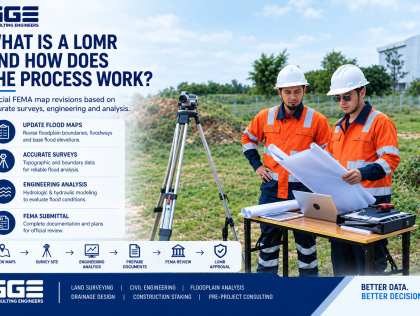
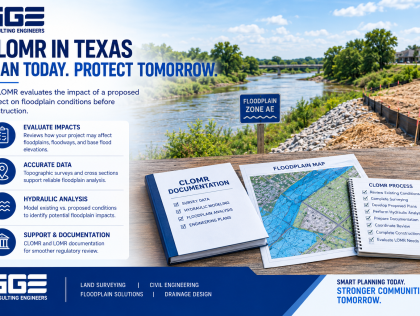
FEMA floodplain mapping affects a significant percentage of developable land in Texas. A parcel that looks buildable on a basic zoning map may sit partially or fully within a Special Flood Hazard Area (SFHA), which fundamentally changes what you can build, where you can build it, and what it will cost to build there.
Discovering a floodplain encumbrance mid-design rather than during due diligence forces expensive redesigns, triggers CLOMR/LOMR submittals, and can add months to your project timeline. In some cases, it renders portions of a site undevelopable without significant earthwork or flood mitigation infrastructure.
The fix: Conduct a thorough floodplain analysis as part of your pre-project due diligence. For sites with any proximity to waterways, drainage channels, or mapped FEMA zones, engage a civil engineering firm capable of performing a FEMA Letter of Map Revision (LOMR) submittal if needed.
Mistake 4: Poor Drainage and Stormwater Planning
Drainage problems are one of the leading causes of both construction delays and post-construction headaches. Sites with inadequate stormwater management create ponding that halts construction operations, erodes graded areas, and damages completed work.
In Texas, stormwater requirements are particularly stringent for commercial and industrial developments. Detention pond sizing, outfall design, and compliance with local MS4 permits all require careful engineering not assumptions based on neighbouring sites.
The most common drainage errors in site development include:
- Undersized detention basins that can’t meet release rate requirements
- Improper grading that directs runoff toward structures or property lines
- Missing or inadequate silt fence and erosion control during construction
- Failure to account for impervious cover increases and their downstream effects
The fix: Engage a civil engineer to design a compliant storm water management plan early in the design process, not as an afterthought. Drainage design should be integrated with grading, not added on top of it.
Mistake 5: Misreading Zoning and Entitlement Requirements
Assuming a parcel’s zoning permits your intended use is a dangerous shortcut. Zoning codes are layered with use restrictions, setback requirements, height limits, parking ratios, landscaping requirements, and overlay districts that may not be obvious from a basic search.
Parcel rezoning, when needed, is a public process that involves city staff review, planning commission hearings, and sometimes city council approval. That process takes time, and approval is not guaranteed.
The fix: Commission a full zoning and entitlement analysis before signing a purchase agreement or committing to a project schedule. Firms experienced in parcel rezoning can quickly identify whether your intended use requires a variance, special use permit, or full rezoning and what that process will realistically require.
Mistake 6: Inadequate Utility Coordination
Utilities, water, sewer, gas, electric, and telecommunications each have their own coordination timelines, connection fees, and design requirements. A development that requires a new water main extension or a sewer lift station is fundamentally different from one that connects directly to existing infrastructure.
Common utility coordination mistakes that delay construction:
- Assuming utility capacity exists when it does not
- Failing to request utility will-serve letters early in the design process
- Underestimating lead times for new meter installations or service upgrades
- Designing building footprints or parking fields that conflict with existing easements
The fix: Begin utility coordination during preliminary design, not after. Your civil engineer should be coordinating with utility providers in parallel with site design, not sequentially after it’s complete.
Mistake 7: Skimping on Land Surveying
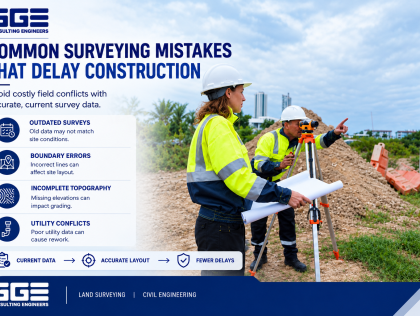
A construction project built on an inaccurate survey is a liability in every direction. Boundary errors, incorrect easement locations, and miscalculated topographic data create conflicts with adjacent landowners, incorrect grading designs, and permit rejections.
Land surveying in Texas requires a Registered Professional Land Surveyor (RPLS). The survey types most relevant to site development include:
| Survey Type | Purpose |
| Boundary Survey | Establishes legal property lines |
| Topographic Survey | Maps existing elevations, drainage, and features |
| ALTA/NSPS Survey | Comprehensive survey for commercial transactions |
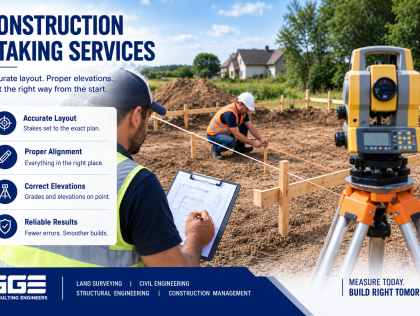
| Construction Staking | Locates improvements during construction |
Cutting corners on survey quality is a false economy. Errors discovered mid-construction are far more expensive to correct than they would have been to prevent.
The fix: Use a licensed, experienced land surveying firm. For commercial developments, an ALTA survey at the due diligence stage protects you from boundary and easement surprises that would otherwise surface during permitting or construction.
Mistake 8: Starting Construction Before Plans Are Complete
Value engineering and fast-tracking are legitimate strategies for aggressive project schedules. Starting construction with incomplete plans is not.
When construction begins before civil drawings are fully issued, the result is almost always a stream of field RFIs, contractor change orders, work stoppages waiting for clarification, and rework when conflicts between disciplines are discovered in the field instead of on paper.
The cost of RFI-driven rework in commercial construction is consistently documented as three to five times the cost of resolving the same issue during design.
The fix: Complete your civil site plans’ grading, drainage, utilities, paving, and erosion control before issuing construction permits. If schedule compression is essential, consult with your engineering team about which packages can legitimately be fast-tracked and which cannot.
Mistake 9: Neglecting Construction Management Oversight
Site development doesn’t end when construction begins. The execution phase carries its own risks: contractors who deviate from plans, subcontractors who create conflicts between trades, inspections that reveal non-conforming work, and material delays that require design substitutions.
Without active construction management, these issues compound silently until they become expensive problems. Owners who assume contractors will self-manage to plan consistently find themselves facing cost overruns and schedule delays that a qualified owner’s representative or construction manager would have caught early.
The fix: Retain a construction management firm or designate an owner’s representative to provide regular site observation, review RFIs and submittals, and maintain schedule accountability. The cost is a fraction of the rework it prevents.
Mistake 10: Choosing the Wrong Engineering Partner
The single most consequential site development mistake is selecting an engineering firm based on the lowest bid rather than demonstrated capability, local experience, and client service.
Engineering firms that lack Texas-specific regulatory experience, relationships with local permitting agencies, or the in-house breadth to handle structural, civil, and survey needs simultaneously create coordination gaps that directly translate to project delays.
An experienced land development engineering firm brings:
- Knowledge of local municipality and TxDOT requirements
- Established relationships with reviewing agencies
- In-house coordination across disciplines that eliminates version control and communication errors
- A track record of on-time permitting approvals
GGE Consulting Engineers has been delivering civil engineering, structural engineering, and land surveying services across Texas for more than 40 years, with zero contract defaults and no compliance claims a distinction that reflects a consistent standard of performance on every project, regardless of size.
The fix: Evaluate engineering firms on experience, references, and demonstrated results in your project type and jurisdiction. The right partner costs the same or less than a cheaper firm that creates expensive delays.

A Quick-Reference Checklist: Site Development Mistakes to Avoid
| Phase | Common Mistake | Prevention |
| Due Diligence | Skipping floodplain and zoning analysis | Commission thorough pre-project review |
| Geotechnical | Insufficient soil investigation | Full geotech report before design |
| Survey | Inaccurate or incomplete survey | Use licensed RPLS with project-type experience |
| Design | Utility coordination delayed until after design | Start coordination during schematic design |
| Permitting | Unrealistic approval timelines | Build jurisdiction-specific timelines from day one |
| Drainage | Stormwater design treated as secondary | Integrate drainage from the start of civil design |
| Zoning | Assuming use is permitted | Confirm entitlements before project commitment |
| Construction | Starting with incomplete plans | Complete civil package before permit submittal |
| Oversight | No active construction management | Retain CM or owner’s rep during construction |
| Engineering Partner | Choosing on price alone | Evaluate on experience, local knowledge, and track record |
What Does Land Development Engineering Actually Cover
Land development engineering is the discipline that bridges raw land and a buildable, code-compliant site. It encompasses everything from the initial feasibility analysis through final construction documents and regulatory approvals.
Core services in land development engineering include civil site design, grading and drainage engineering, utility design and coordination, stormwater management, floodplain analysis, permitting support, and survey integration. On complex projects, it also includes FEMA submittals, TxDOT coordination, and subdivision platting.
The best outcomes happen when the land development engineering team is engaged before the project is fully committed when there’s still flexibility to respond to what the site analysis reveals. At GGE Consulting Engineers, pre-project consulting is a core service specifically designed for this reason: to give owners and developers the technical clarity they need to make confident go/no-go decisions before significant capital is committed.
The Bottom Line on Site Development Mistakes
There is no shortage of ways for a site development project to go sideways. But the pattern behind almost every costly delay is the same: decisions made too fast, with too little information, by teams without deep local experience.
The developers and project owners who consistently deliver on time and within budget are not the ones who move fastest at the start. They’re the ones who invest in thorough due diligence, engage qualified land development engineering professionals early, build accurate permitting timelines, and maintain active oversight through construction.
Site development mistakes aren’t inevitable. They’re predictable, which means they’re also preventable.
If you’re in the planning stages of a development in Texas and want to make sure you’re building on a solid foundation, we recommend exploring what GGE Consulting Engineers can offer. With more than 40 years of experience, in-house civil, structural, and survey capabilities, and a zero-claims record across thousands of Texas projects, GGE is built for exactly this kind of work. Contact us to discuss your project or request a quote.
Frequently Asked Questions
What are the most common causes of construction delays during site development?
Permitting delays, poor drainage design, incomplete utility coordination, and unidentified soil conditions are the top causes, and most are preventable with proper upfront planning.
How early should I engage a land development engineering firm?
Before signing a purchase agreement. Early land development engineering review can surface floodplain, zoning, or utility issues that affect project feasibility before you’re committed.
What is the difference between a civil engineer and a land development engineer?
Land development engineering is a civil engineering specialty focused on site planning, design, and permitting. Not all civil engineers specialize in site development; look for demonstrated experience in your project type.
How long does site development permitting take in Texas?
Anywhere from 6 weeks to 8+ months depending on jurisdiction and project complexity. Projects involving FEMA floodplain review or TxDOT coordination take the longest.
Do I need a land surveyor and a civil engineer, or can one firm provide both?
One firm that offers both streamlines coordination and reduces errors. GGE Consulting Engineers provides civil engineering, structural engineering, and land surveying under one roof.