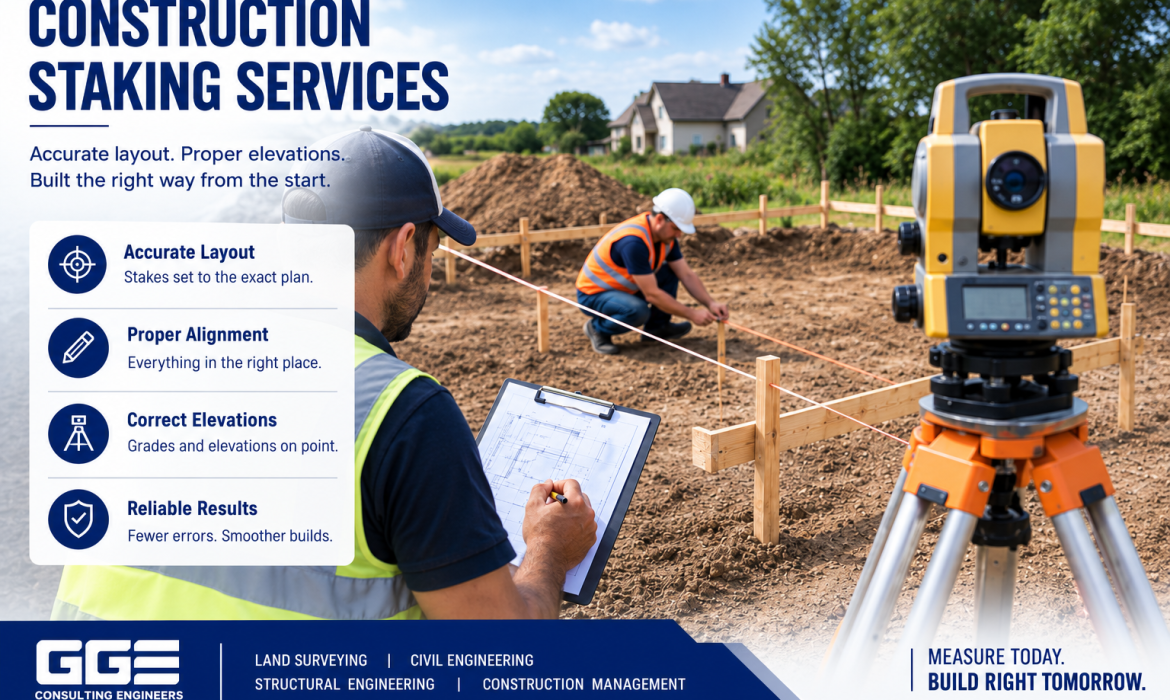
Construction projects depend on accuracy from the first survey through final installation. Before a contractor begins building roads, foundations, utilities, drainage systems, or other improvements, the design shown on engineering drawings must be transferred accurately to the physical site. This process is known as construction staking.
For developers and contractors in Texas, construction staking services help establish the horizontal and vertical control needed to construct improvements according to approved plans. Accurate staking can help reduce layout errors, support proper grading, and give construction crews clear points of reference throughout the project.
GGE Consulting Engineers integrates land surveying, civil engineering, structural engineering, and construction management to support projects from planning through construction. Understanding how construction staking works and why it matters can help property owners and project teams make better decisions before construction begins.
What Is Construction Staking?
Construction staking is the process of transferring design information from approved engineering and construction documents to physical points on the ground. A survey professional uses established control points, coordinates, elevations, and project drawings to identify where specific improvements should be constructed.
Stakes, hubs, nails, paint markings, offsets, and other field indicators can communicate the location and elevation of proposed improvements. Depending on the project, staking may identify building corners, foundation lines, utility alignments, road centerlines, curbs, drainage structures, grades, and other important construction elements.
The purpose is straightforward: contractors need reliable field information that tells them where and at what elevation to construct the improvements shown in the plans.
This makes construction staking an important connection between engineering design and actual construction.
For projects that require broader land measurement and property information, GGE Consulting Engineers’ Land Surveying services can provide the surveying support needed before and during development.
Why Construction Staking Matters Before Building
A set of engineering plans can contain precise coordinates, dimensions, elevations, and design information, but those details still need to be established in the field. Construction staking provides the physical reference points that allow contractors to follow the approved design.
Without reliable layout information, construction crews may have difficulty determining the exact position of improvements. Even a relatively small layout error can affect setbacks, utility connections, drainage patterns, road alignment, foundation placement, and coordination with surrounding improvements.
Construction staking is particularly important when several project elements must work together. For example, a building foundation may need to align with site grading, parking areas, underground utilities, stormwater infrastructure, and property boundaries.
Accurate field layout helps maintain consistency between these elements.
What Does Construction Staking Include?
Construction staking services can include establishing the precise locations, alignments, and elevations needed for different phases of a construction project. The exact scope depends on the project type, approved plans, site conditions, and contractor requirements.
Common construction staking activities include:
- Building and foundation layout
- Road and pavement alignment
- Utility line staking
- Stormwater and drainage structure layout
- Curb and sidewalk layout
- Site grading and elevation control
- Structure and column location
- Offset staking
- Construction control points
- As-built field information
Not every project requires all of these services. The staking plan should be coordinated with the approved construction documents and the contractor’s schedule.
Horizontal and Vertical Control in Construction Staking
Two fundamental components of construction staking are horizontal control and vertical control.
Horizontal Control
Horizontal control establishes the location of improvements across the site. This can include the position of a building, road centerline, utility alignment, property-related improvements, or other site features.
Surveyors use established coordinates and control points to transfer these locations into the field. Proper horizontal control helps ensure that improvements are positioned where the plans specify.
This is especially important when projects have limited space or multiple improvements located close to one another.
Vertical Control
Vertical control establishes elevations. It helps contractors determine how high or low an improvement should be constructed relative to the project’s established datum or benchmark.
Elevation control can affect:
- Finished floor elevations
- Road grades
- Drainage slopes
- Utility elevations
- Stormwater structures
- Pavement elevations
- Curb and sidewalk grades
- Site grading
Incorrect elevation can create serious construction problems, particularly on sites where drainage depends on carefully designed slopes.
For more information about the engineering side of site preparation, see GGE Consulting Engineers’ Civil Engineering services.
Common Types of Construction Staking
Construction staking can occur at different stages of a project. The required staking depends on what is being constructed and what information the contractor needs at each phase.
|
Staking Type |
Typical Purpose |
|
Building layout |
Establish building corners, walls, and foundation locations |
|
Utility staking |
Identify utility alignments and connection locations |
|
Road staking |
Establish centerlines, grades, and roadway features |
|
Grading staking |
Provide elevation information for earthwork |
|
Drainage staking |
Locate drainage structures and establish elevations |
|
Offset staking |
Preserve layout references away from active construction |
|
Structural layout |
Establish locations for foundations, columns, and structural elements |
The surveyor may return to the site multiple times as construction progresses. Staking is therefore not necessarily a single field visit. Complex projects often require layout information at different construction milestones.
Construction Staking for Texas Development Projects
Texas development projects can involve large sites, changing terrain, extensive infrastructure, and multiple regulatory requirements. Construction staking must therefore be coordinated carefully with the approved design documents and existing site conditions.
A construction staking surveying contractor in Texas project teams should understand how surveying information relates to civil design, structural elements, site grading, utilities, and construction sequencing.
Local project conditions can also influence the staking approach. A commercial development in San Antonio may have different site requirements from a subdivision, roadway improvement, or utility project elsewhere in Texas.
For this reason, construction layout should be based on the project’s actual plans, control network, site conditions, and construction requirements rather than relying on generic field assumptions.
When Should Construction Staking Begin?
Construction staking should be planned before the contractor needs the layout information in the field. Waiting until crews are ready to begin a particular activity can create unnecessary scheduling pressure.
Before staking begins, the project team should confirm that:
- The appropriate construction drawings are approved and current.
- Survey control has been established and verified.
- Relevant design revisions have been incorporated.
- The contractor’s construction sequence is understood.
- Required access to the site is available.
- The surveyor has the information needed for field layout.
Early coordination is particularly important when multiple contractors or subcontractors will rely on the same control information.
GGE Consulting Engineers’ Construction Management services can also support coordination between design information, contractor activities, field observations, and construction documentation.
Construction Staking and Building Foundations
Building foundations require accurate positioning because their location affects the entire structure above them. Foundation staking may establish building corners, foundation lines, column locations, grid intersections, or other structural reference points.
An error at this stage can carry through later construction activities. Walls, columns, framing systems, utilities, and architectural components may all depend on the foundation being placed correctly.
For projects involving structural design, GGE Consulting Engineers also provides Structural Engineering services that can be coordinated with site and surveying requirements.
This integrated approach helps the project team maintain consistency between structural drawings, civil plans, and field layout.
The Role of Offset Stakes
Construction areas can change quickly. Excavation, grading, trenching, and equipment movement may remove or disturb stakes placed directly on construction lines.
Offset staking helps address this issue.
Instead of placing every reference directly on the construction line, surveyors can establish offset points at a known distance from the intended location. Contractors can then use those references to reconstruct the required alignment after excavation or other site activities.
Offset control can be especially useful for:
- Building foundations
- Utility trenches
- Roadway alignments
- Curbs
- Structural elements
- Site improvements
The appropriate offset distance and marking method depend on site conditions and the construction activity involved.
How Construction Staking Supports Quality Control
Construction staking is not a replacement for inspections or construction quality control. Instead, it provides accurate field references that help contractors build according to the approved design.
A strong construction process typically connects several activities:
Surveying → Engineering Design → Construction Staking → Construction → Field Verification → As-Built Documentation
Each stage provides information needed by the next.
If the design is based on reliable survey information and the field layout is based on the approved design, the project team has a stronger foundation for maintaining consistency.
For projects requiring broader construction oversight, GGE’s Pre-Project Consulting services can help identify design, constructability, and coordination issues before construction begins.
What to Look for in Construction Staking Services
Property owners, developers, and contractors should evaluate construction staking based on technical capability and project coordination rather than simply treating it as a routine field task.
Important considerations include:
- Experience with similar project types
- Ability to work from current approved plans
- Understanding of horizontal and vertical control
- Familiarity with local Texas project requirements
- Coordination with civil and structural design
- Ability to respond to construction sequencing
- Clear documentation of field control
- Proper professional oversight
The survey team should also understand how field conditions can affect staking requirements. Site activity, disturbed control points, excavation, weather, and design changes may require additional verification.
Why Surveying and Engineering Coordination Matters
Construction staking becomes more effective when the surveying team and engineering team understand the same project information.
GGE Consulting Engineers provides land surveying, civil engineering, structural engineering, and construction management as connected disciplines. This allows survey information and design information to be coordinated throughout the project lifecycle.
For a development project, the workflow may begin with land surveying and existing conditions, continue through civil and structural design, and then move into construction layout and field coordination.
This reduces the risk of information being misunderstood when it moves between separate project teams.
The goal is not simply to place stakes in the ground. The goal is to provide reliable field control that supports the design intent.
Construction Staking Checklist for Project Teams
Before construction staking begins, project teams should confirm the following:
- Current approved construction drawings are available.
- Project coordinates and datum are established.
- Survey control points have been verified.
- Design revisions have been reviewed.
- Construction sequencing has been communicated.
- Required staking locations are identified.
- Elevation requirements are clearly defined.
- Offset requirements are understood.
- Site access is available for field crews.
- Additional staking needs are anticipated for later phases.
This preparation helps reduce interruptions and allows survey crews to provide the information contractors need at the right stage of construction.
Conclusion
Construction staking is an important part of turning engineering plans into physical improvements. By establishing accurate horizontal locations, elevations, alignments, and reference points, staking gives contractors the field information needed to construct according to the approved design.
For Texas development projects, accurate layout can support foundations, utilities, grading, roads, drainage systems, and other critical improvements. It is also most effective when coordinated with the project’s land survey, civil engineering, structural engineering, and construction management requirements.
GGE Consulting Engineers brings these disciplines together to support projects from surveying and design through construction. If your project requires accurate field layout or coordinated engineering support, Contact us to discuss your construction staking requirements and project needs.
Frequently Asked Questions
What are construction staking services?
Construction staking services transfer approved design information to physical points on a construction site. They help contractors accurately locate structures, utilities, roads, drainage features, and other improvements.
Why is construction staking important before building?
Construction staking helps establish the correct location and elevation of proposed improvements. It can reduce layout errors and help contractors follow the approved construction plans accurately.
What does a construction surveyor stake?
A construction surveyor may stake building corners, foundations, utilities, roads, drainage structures, grading points, curbs, and other improvements. The exact scope depends on the project plans and construction phase.
Is construction staking the same as a boundary survey?
No. A boundary survey identifies property boundaries and related land information. Construction staking transfers proposed design elements from engineering plans to specific locations in the field.
When should construction staking be scheduled?
Construction staking should be scheduled before contractors need layout information for a specific construction activity. Early coordination allows surveyors to review current plans and establish the required control.
Does construction staking include elevation control?
Yes, construction staking can include vertical control for required grades and elevations. This is important for foundations, roads, drainage systems, utilities, sidewalks, and other site improvements.
Can construction staking be needed more than once?
Yes. Staking may be required at several construction stages as different improvements are built. Additional layout may be needed for foundations, utilities, grading, paving, drainage, or structural elements.