Civil engineering for developers is one of the most direct levers for keeping construction projects on schedule. The right civil engineering team like GGE Consulting Engineers prevents permitting bottlenecks, eliminates design conflicts, coordinates utilities before they become crises, and catches site constraints that would otherwise surface mid-construction at the worst possible time.
Most project delays aren’t caused by bad luck. They’re caused by gaps in planning, coordination, and site analysis that a qualified land development engineering team would have caught before a single permit was submitted.
Whether you’re developing a commercial site, a residential subdivision, or a public infrastructure project, here’s exactly how civil engineers reduce delays and what happens when that expertise is missing from your project team.
The Real Cost of Project Delays in Development
Schedule slippage doesn’t just push back your opening date. It multiplies costs in ways that are difficult to fully anticipate at the outset.
Extended construction timelines mean longer draws on construction financing, which increases carrying costs. Delayed occupancy means delayed rental income or sales revenue. Contractor mobilization gaps create rescheduling costs. Municipal permit extensions trigger additional fees. And if delays push a project past a seasonal weather window particularly relevant for grading and concrete work the schedule can slip by months, not weeks.
Industry data consistently shows that construction schedule overruns range from 20 to 40 percent on projects where site planning and engineering coordination were insufficient at the outset. The pattern is predictable: the less civil engineering for developers is integrated early, the more expensive the corrections become later.
What Civil Engineers Actually Do for Developers
This is where a lot of generic content gets vague. Civil engineering for developers isn’t just “designing roads and drainage.” It’s a comprehensive discipline that covers every system a site needs to function and every regulatory hurdle that stands between raw land and a certificate of occupancy.
Here’s what that looks like in practice:
| Civil Engineering Service | What It Prevents |
| Site feasibility analysis | Committing to a parcel with hidden constraints |
| Grading and drainage design | Drainage failures, permit rejections, construction flooding |
| Utility coordination | Mid-construction conflicts, service delays, capacity surprises |
| Stormwater management | MS4 permit violations, detention basin failures |
| Permitting support | Incomplete submittals, revision cycles, approval delays |
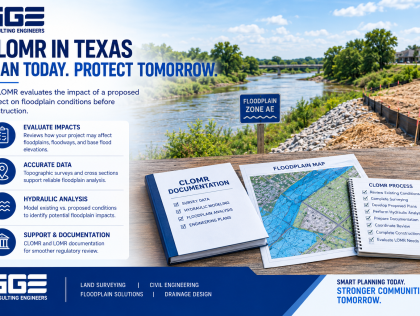
| Floodplain analysis | FEMA-related design changes and LOMR/CLOMR timelines |
| Construction administration | RFI backlogs, contractor deviations from plan |
Each of these services addresses a specific category of delay. Together, they form the backbone of a project that moves efficiently from entitlement to construction to occupancy.
How Civil Engineers Reduce Delays at Every Project Phase
Phase 1: Due Diligence and Pre-Project Analysis
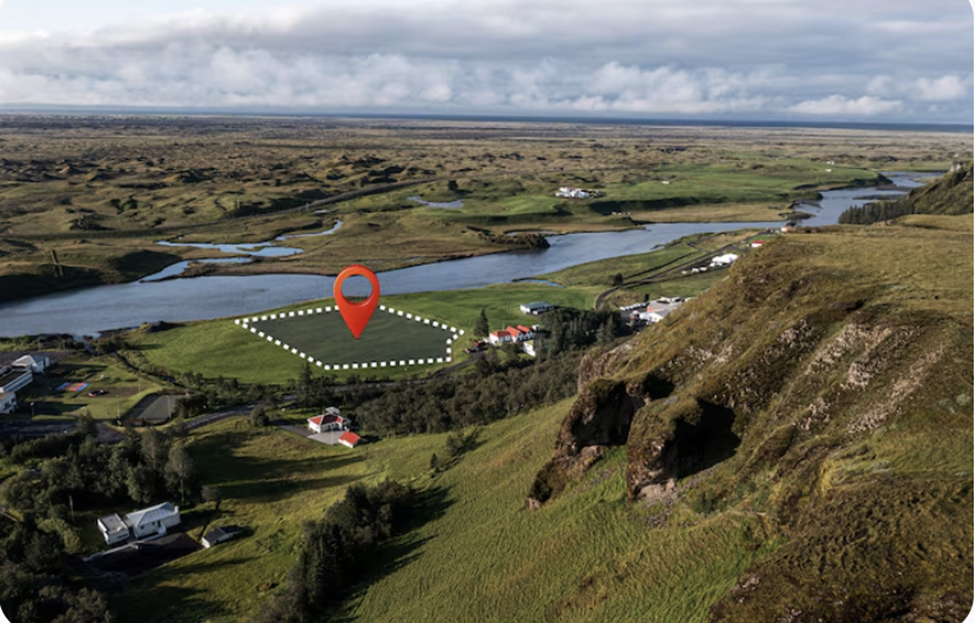
The most valuable thing a land development engineering team does happens before design even starts. Pre-project analysis identifies the constraints that will shape or derail your project if they’re discovered too late.
This includes floodplain mapping review, utility availability assessment, zoning and entitlement confirmation, geotechnical evaluation, and a realistic permitting timeline based on the specific jurisdiction and project type.
Developers who skip this phase or rush through it frequently encounter one of the following mid-project:
- A FEMA floodplain that requires a CLOMR submittal, adding 6–12 months to the schedule
- A utility capacity limitation that requires a new main extension, adding cost and time
- A zoning conflict that requires a variance or rezoning before permits can be issued
- Soil conditions that require a redesigned foundation or significant import/export of material
None of these are unforeseeable. They’re all identifiable with proper due diligence and a qualified civil engineering firm conducts that due diligence as a standard first step, not an afterthought.
Phase 2: Design and Permitting
Civil engineering for developers during the design phase is about producing permit-ready documents the first time, not going through two or three rounds of city comments and revisions.
Permit revision cycles are one of the most common and underappreciated sources of project delay. Each round of comments from a reviewing agency typically takes two to four weeks to process. A project that goes through three revision cycles has just lost six to twelve weeks before a single permit is issued.
Experienced civil engineers reduce revision cycles by knowing exactly what each municipality requires before submitting. That means:
- Following local design standards precisely, not generic national standards
- Pre-coordinating with reviewing agencies on complex or unusual design elements
- Anticipating comments based on familiarity with the reviewers and their priorities
- Submitting complete packages that don’t trigger automatic holds for missing information
Here’s a look at how permitting timelines vary by project complexity and the role land development engineering plays in managing them:
| Project Type | Typical Permitting Timeline (Without Engineering Support) | With Experienced Civil Engineering Team |
| Simple commercial pad site | 8–14 weeks | 6–10 weeks |
| Multi-tenant retail or office | 12–20 weeks | 10–16 weeks |
| Residential subdivision | 16–32 weeks | 12–24 weeks |
| Project in FEMA floodplain | Add 3–12 months | Managed through proactive LOMR strategy |
| TxDOT access permit required | Add 4–8 weeks | Coordinated in parallel, not sequentially |
The difference isn’t marginal. On a mid-size commercial project, the right civil engineering for developers can recover two to four months on the schedule before construction even begins.
Phase 3: Utility Coordination
Utility conflicts are a persistent source of construction delay that most developers don’t fully account for in their schedules. Water, sewer, gas, electric, and telecommunications providers each have their own approval processes, design requirements, lead times, and coordination contacts.
A civil engineering team that has worked extensively in a region knows these systems who to call, what they need, and how long each step realistically takes. They coordinate utility connections in parallel with site design, not after civil drawings are complete.
The most common utility coordination failures that delay projects:
- Discovering that existing sewer capacity is insufficient, requiring a main upgrade
- Failing to request a utility will-serve letter until after design is complete
- Designing site improvements that conflict with existing utility easements
- Underestimating lead times for electric transformer installations or service upgrades
An experienced land development engineering firm treats utility coordination as a parallel workstream, not a downstream task. That discipline alone routinely saves four to eight weeks on project schedules.
Phase 4: Construction Administration
Civil engineering for developers doesn’t stop when permits are issued. The construction phase introduces its own risk of delay: contractor deviations from approved plans, inspection failures, RFIs that pile up while the engineering team is slow to respond, and substitution requests that require municipal re-review.
Active construction administration by the civil engineering team catches these issues early. Site observation visits identify grading or utility installation that doesn’t match the approved plans before inspectors flag it. Prompt RFI responses keep contractors moving. Proactive communication with inspectors reduces the risk of failed inspections that halt work.
The difference between a civil engineering firm that provides thorough construction administration and one that disappears after permit issuance is often the difference between a project that closes out on schedule and one that drags through punch lists and re-inspection cycles for months.

The Three Ways Developers Underuse Civil Engineering
1. Engaging the Civil Engineer Too Late
The most common mistake is treating civil engineering for developers as a design service rather than a planning resource. Developers who bring their civil engineer in after a purchase agreement is signed or, worse, after a site plan concept has already been developed lose the benefit of early constraint identification.
The engineer ends up reverse-engineering a design around site conditions that could have been accommodated from the start if they’d been involved in pre-contract due diligence.
2. Separating Survey and Civil Engineering
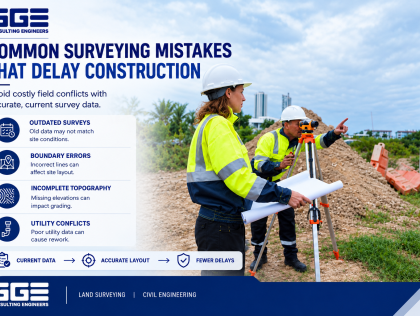
Land surveying and civil site design are deeply interdependent. When these services come from different firms, coordination gaps are common: inconsistent datum references, topographic data that doesn’t match the civil design base, and easement locations that conflict with proposed improvements.
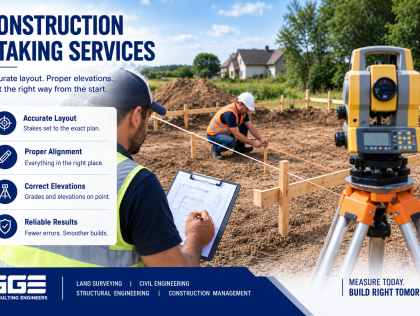
Using a firm that provides both land development engineering and land surveying in-house eliminates this coordination layer entirely. GGE Consulting Engineers provides civil engineering, structural engineering, and land surveying under one roof, a model specifically designed to prevent the handoff errors that create delays.
3. Choosing Engineering Partners on Price Alone
A civil engineering fee that’s 15 percent lower than competing proposals is not a savings if the firm’s permitting revision rate is twice as high, their construction administration is minimal, or their local agency relationships require introductions instead of existing working relationships.
Civil engineering for developers is not a commodity service. The difference in outcomes between a highly experienced local firm and a lower-cost generalist is measured in weeks of schedule and significant dollars in carrying costs, rework, and contractor inefficiency.
What to Look for in a Civil Engineering Partner
Developers evaluating civil engineering for developers firms should ask specific questions:
| Evaluation Criteria | What to Ask |
| Local permitting experience | How many projects have you permitted in this municipality in the last three years? |
| Revision cycle rate | What’s your typical number of permit revision rounds on commercial projects? |
| In-house capabilities | Do you provide civil, structural, and survey services in-house? |
| Construction administration | What does your CA scope include, and how frequently do you visit the site? |
| Agency relationships | Have you worked directly with the reviewing engineers at this city? |
| Track record | Can you provide references from developers with similar project types? |
A firm that answers these questions with specifics, not generalities, is a firm that has earned those answers through consistent performance.
GGE Consulting Engineers has served developers, governmental agencies, and commercial project owners across Texas for more than 40 years. With offices in San Antonio, Austin, and Corpus Christi, and a zero-claims record across every engagement, GGE brings the local depth, in-house breadth, and track record that translate directly to fewer delays and better project outcomes.
The Bottom Line on Civil Engineering for Developers
Project delays are not inevitable. They are, in the vast majority of cases, the downstream result of planning gaps, coordination failures, and engineering decisions made too late or by the wrong team.
Civil engineering for developers, when engaged early, executed by an experienced team, and maintained through construction, is the most reliable tool for keeping a project on schedule. It’s not overhead. It’s the discipline that makes every other phase of development work the way it’s supposed to.
Land development engineering professionals who know your jurisdiction, understand your project type, and bring in-house survey and structural capabilities to the table don’t just reduce delays. They eliminate entire categories of risk before those risks become schedule problems.
If your next development project deserves a civil engineering team built for it, not a generic plan applied to it, explore what it can offer. With more than 40 years of Texas experience, offices in San Antonio and Corpus Christi, and a zero-claims track record, GGE is the partner developers rely on when schedule and quality both matter.
Ready to get started? Contact us today — our team is available to review your project, answer your questions, and help you build a timeline that actually holds.
Frequently Asked Questions
What does civil engineering for developers typically include?
It covers site feasibility, grading and drainage design, utility coordination, stormwater management, permitting support, and construction administration everything needed to take a parcel from raw land to a permit-ready, buildable site.
How early should a civil engineer be involved in a development project?
Before you sign the purchase agreement. Pre-project due diligence by a civil engineering for developers team can identify constraints that affect project feasibility, cost, and schedule before you’re financially committed.
How does land development engineering differ from general civil engineering?
Land development engineering is a specialty focused on the planning, permitting, and design of sites for construction. It requires deep familiarity with local regulations, municipal review processes, and site-specific systems not just general civil engineering principles.
Can one firm handle civil engineering, structural engineering, and land surveying?
Yes, and it’s the most efficient model. Firms like GGE Consulting Engineers that provide all three services in-house eliminate coordination gaps between disciplines that commonly cause errors and delays.
What’s the most common civil engineering mistake that causes project delays?
Insufficient pre-project due diligence, specifically failing to identify floodplain constraints, utility limitations, or permitting triggers before design begins. These issues are entirely preventable with proper upfront analysis.